

Read in 90 seconds:
- Notable C-Suite Moves
- What’s New In Tech
- C-Suite Trends For Leaders
- From the Podcast
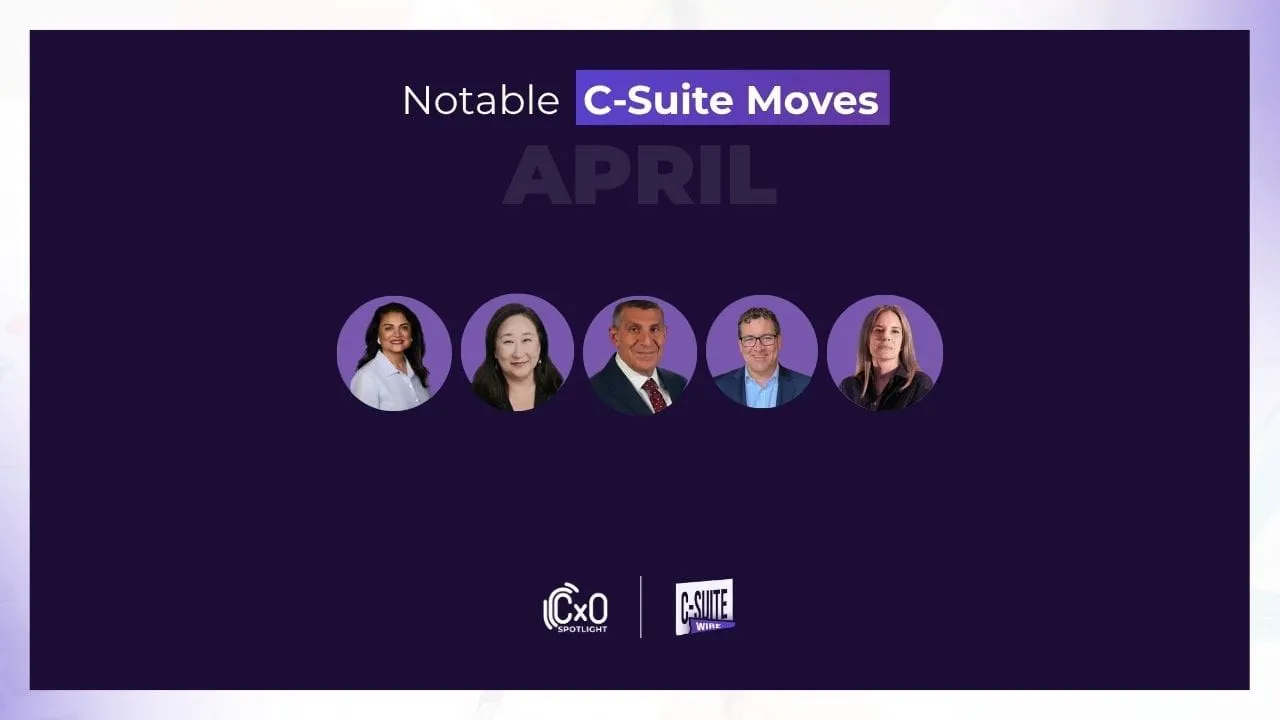
Notable C-Suite Moves (April)
- Ann Nanda-> Chief Growth Officer, Zinnia. Lead growth strategy, focusing on market expansion and client partnerships. Held leadership positions at Prudential Financial.
- Cindy Zhou-> Chief Marketing Officer, Imprivata. Lead marketing and brand strategy at Imprivata as it scales its access management platform. Held leadership positions at the WSJ Leadership Institute CMO Council, and advises Sendoso.
- Francesco Tinto-> Chief Information and GBS Officer, Kimberly-Clark. Lead global technology and shared services to drive modernization and efficiency. Held CIO roles at Walgreens Boots Alliance and Kraft Heinz.
- Jon Beaulier-> Chief Revenue Officer, Snowflake. Lead global revenue and go-to-market strategy. He has been with the company since 2016, holding multiple senior sales leadership roles.
- Jessica Block-> Chief Artificial Intelligence Officer, RGP. Lead AI strategy at RGP, focusing on internal capabilities and client solutions. She previously led growth and transformation at Factor and held senior roles at Ankura and FTI Consulting.
What’s New in Tech
Nearly 90% of technology leaders remain focused on employee or process-level GenAI initiatives, while fewer than 37% are working on enterprise-level AI transformation capable of driving industry disruption.
AI is beginning to reshape workflows, operating models, and even business models. The real disruption is in how it changes cost structures, decision-making speed, and value creation over time.
At the same time, the hype cycle is stabilizing. Investment is shifting away from surface-level GenAI experimentation toward deeper foundations like AI-ready data, AI agents, and engineering systems that can actually scale.
This is where most organizations are not ready. They are adopting tools faster than they are redesigning systems. For new executives stepping into AI-heavy roles, this creates a very specific challenge. You are walking into partial adoption, unclear outcomes, and rising expectations.
The opportunity shifts from “introduce AI” to connecting fragmented efforts into a system that actually delivers outcomes.
C-Suite Trends for Leaders
Most executives assume their challenge in a new role is execution, but it is navigation.
New CXOs consistently run into three constraints: limited time, incomplete information, and a lack of trusted relationships. In AI-heavy roles, these constraints intensify.
Here’s how the most effective leaders are approaching it:
1. Start With Clarity
The pressure to “do something” quickly is high. But early success is regulating the volume of initiatives by choosing the right ones.
Strong CXOs anchor themselves on one question: Why am I appointed for this role?
From there, they identify a few high-impact areas where progress is visible and meaningful. These are focused moves that create credibility early. Quick wins are strategic signals.
2. Build a Real View of the Organization
What you see in the first 30 days is rarely the full picture. Most AI and tech initiatives look aligned on the surface, but are fragmented underneath. There are different teams, goals, and definitions of success.
Effective CXOs move fast to build three snapshots:
- Where is the business actually trying to create value?
- What capabilities exist today vs what is assumed?
- Where are current AI efforts stalling or misaligned?
Without this, decisions get made on incomplete context.
3. Prioritize Signal Over Noise
AI environments are noisy by default. There are too many tools, pilots, and opinions. CXOs who succeed don't bite more than they can chew and filter aggressively.
They focus on:
- initiatives tied to measurable business outcomes
- efforts that can scale beyond experimentation
- areas where adoption, not just deployment, is possible
4. Redefine Your Role Across the C-Suite
Technology leadership is now a co-ownership role. The shift is from: explaining systems → shaping business decisions
CXOs who drive impact position themselves as partners in:
- revenue growth
- cost structure decisions
- risk and resilience
- customer experience
Change how you communicate by bringing business clarity and aptitude to the conversation.
5. Build Trust Before You Scale Influence
Without trust, even the best AI strategy stalls. High-impact CXOs invest early in:
- understanding stakeholder priorities and pressures
- aligning initiatives with what matters for each executive
- Adapting communication to different decision styles
Trust allows AI initiatives to move beyond pilots into real execution.
The first year in a new role, especially in AI-led environments, is creating clarity in ambiguity, building trust in uncertainty, and driving outcomes where expectations are still undefined. That is where real leadership shows up.
From The Podcast
Why Strategy Is the New Operating System
In this CXO Spotlight episode, Candace Holt, Chief Strategy Officer at C1, explains why strategy is the framework for execution, how organizations actually prioritize when everything seems urgent, and what buying decisions look like from inside the C-suite.
Why this matters: Most leadership teams don’t struggle with ideas, but with decision friction. Candace’s approach shows how strategy becomes a mechanism to reduce noise, make trade-offs visible, and move the organization forward without consensus paralysis.
📢 Get Featured
Are you an executive, board member, or company insider in North America? Share verified C-suite appointments for CXO Spotlight feature here: https://www.thecxospotlight.com/get-feaured/
Enjoyed this issue? Forward to a colleague, subscribe, and follow us on LinkedIn for daily CXO updates.